Showing posts with label Dover. Show all posts

Wednesday, August 21, 2013

Tuesday, July 2, 2013

Maps of Dover

I spent quite a bit of time trying to find maps of Dover, and came away feeling rather unsuccessful.

Heres the maps I found.  I'm still searching for something better.

This map is from sometime in the 1800s


And this one is from 1900
This map is the closest to how the town was arrayed, and the docks/breakwaters were laid out, in 1923


Friday, June 7, 2013

the Port of Dover

The gap in the cliffs, plus its proximity to the continent, has meant that the site of Dover has been used for shipping from at least Roman times.  A small artificial harbour has existed since at least 1495. From 1606, the Lord Warden of the Cinque Ports had responsibility for the harbour. Soon it was used by small fast sailing craft carrying mails to Calais and Ostend - the first Channel 'packets'. By the mid 18th Century, three dock basins had been constructed.

The Prince of Wales Pier was opened in 1902. This had a stone outer end connecting to land by a cast iron section. Large ocean-going passenger liners such as the "Deutschland" and "Amerika" of the Hamburg America Line called here for a time.  The cast iron section was boxed in with concrete when the Western Docks Hoverport was built in 1978.  The Admiralty Pier protecting the west of the harbour was opened in 1909 by King George V, as the final part of the Admiralty Harbour. The pier was later widened at the seaward end, and Dover Marine Station opened for public services in 1919 (it had been used for hospital trains in the First World War). Dover Harbour Board took full control of the port in 1923.

The first tentative steps towards car ferries began in 1928.  Ships loaded cars with cranes unless tides suited portable side ramps.

Prince of Wales Pier

S.S. Amerika at Dover

S.S. Deutschland at Dover

Admiralty Pier and Harbour, Dover

Admiralty Pier and Harbour, Dover

Thursday, June 6, 2013

Dover Light House, Dover

South Foreland Lighthouse is a Victorian lighthouse on the South Foreland in St. Margaret's Bay, Dover, Kent, England, used to warn ships approaching the nearby Goodwin Sands. It went out of service in 1988 and is currently owned by the National Trust. South Foreland was the first lighthouse to use an electric light. By 1875 the lighthouse was using carbon arc lamps powered by a steam driven magneto.

The South Foreland Lighthouse was used by Guglielmo Marconi during his work on radio waves, receiving the first ship-to-shore message from the East Goodwin lightship, the first ship-to-shore distress message (when a steamship ran into the same lightship, and the lighthouse relayed the message up the coast to the Walmer lifeboat), and the first international transmission (from Wimereux, France, in 1899).

Originally there was another lighthouse further down towards the cliff edge to give a bearing on the leading lights principle when a ship was at the point where it could safely turn left into the Downs behind the sands or right to go safely around the Sands. They were both built in the 1840s. However, the Sands shifted over the following years until this bearing became dangerously inaccurate and so the lower light was taken out of service in 1910. It still survives as part of a private garden but is under threat from cliff erosion.

A view of the South Foreland Lighthouse, overlooking the Dover Cliffs

A drawing of the South Foreland Lighthouse


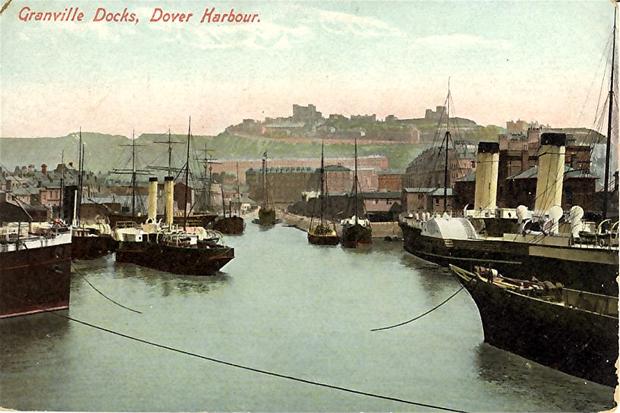
And, just because I like it: A postcard showing the western docks of Dover Harbour

Sunday, December 30, 2012

Dover

Dover is a town and major ferry port in South East England.  Its also the last part of the players journey in England.  From here, they'll board a ferry to France where they'll board the Orient Express.  Dover is famous for its chalk cliffs (the White Cliffs of Dover), and the narrow sea passage between England and France.  its strategic position has been evident througout history, archaeolgical finds have revealed that the area has always been a fous for people entering and leaving Britain and has been inhabited since the Stone Age - who knows what cults are hidden in the back alleys and basements of Dover.

Dover Train Station